
Confusion
The Fog of War, Social Media As an Increasingly Negative Alternative to MSM News, North American and European MSM Gone AWOL, Strategic Comms Ambiguity

Part 1 of 2 - (Second Part out tomorrow)
I have a somewhat large social media following, and I tend to do my out loud thinking there instead of here for reasons that are entirely about one thing only: quality. On social media, I ask questions out loud and float thoughts, not only to gauge reaction (as relying on basic A/B testing would be unethical), but more to see how the words that I choose to arrange in a sentence to form the idea look to me. In a way, it’s like looking in a mirror while getting ready to step out.
On social media, I get bombarded with questions, and often the deluge is simply too much to bear. That is a price of having a large following. Sometimes, the questions are good or even very good. Sometimes they are horrible, or are based on misreadings of what I have written. The worst are those that are based on second or third-hand misunderstandings of my views. I mainly ignore those. The best ones are ones that make me think and that force me to revisit my priors.
Roughly one week into this new war, I made a comment that suggested that the next three or four days would tell us where this war was going. I had several people remind me of this when that time frame elapsed, hoping that I would provide them an answer. I did give them one…I replied: “I don’t know.”
This was the only honest answer that I could provide at the time. Thankfully, most of those who responded were appreciative of my sincerity, knowing full well that it was also unsatisfactory in terms of obtaining knowledge. I strive at all times not be a bullshit merchant, even if that line of work is much, much more lucrative than this one has been. If you ask me today where I think that this war is headed, my answer will be much the same, albeit with more of the gaps filled in since I was first asked that question.
Why is that?
There are several reasons, but the overarching one is that information on this war has been incredibly shoddy and very, very unreliable. Ever war sees the proverbial “Fog of War” descend on it, but this time it’s as thick as pea soup. Reporters on the ground in Iran are scant, while reporting from Israel and the countries that form the GCC are severely censored, if permitted to report at all. Factor into this the lack of US print media foreign-based reporting, forcing them to rely on updates from the US State Department, White House or DoD (Department of Defense).. Even the Brits and Europeans have gone AWOL when they should be covering this war.
What about the internet, the so-called “democratization of media”? I am very sorry to report that its performance has been even worse than mainstream media in terms of war coverage. During previous conflicts, news aggregator sites like Twitter were excellent resources to track wars to their most minute level. A lot of the heavy lifting is traditionally performed by OSINT (Open Source Intelligence) accounts who rely on a wide range of sources, spanning everything from satellite imagery through to local media outlets, and HUMINT (Human Intelligence). The beauty of OSINT is that trustworthiness is very easy to set ablaze as claims can be verified rather quickly…..or so it seemed (more on this in a bit).
Unfortunately, social media is now a new battleground between opposing sides, and between spectators who have chosen to pick sides. This might provide comedic relief, and it does entertain, but only to the detriment of trying to find out what is actually going on in this war. To borrow an overused term, social media has become “weaponized”. This state of affairs muddies the water, as belligerents choose to flood the zone with disinformation, misinformation, and malinformation in order to not just engage in psychological warfare against their enemy, but to also build support for their cause at home and abroad. Compounding matters is the monetization of social media that incentivizes bad actors to pump out sensationalist imagery and “takes” in order to cash in, which makes them guilty of war profiteering in a way. The rapid rise of AI-produced media makes this dishonesty all the more cheaper to create. I have had to turn back to mainstream media to try and divine the truth regarding this conflict.
If Vietnam was the “First Televised War”, and if the First Gulf War was the “First 24 Hour News War”, then this showdown can be argued to be the “First Fake News on Social Media War” (admittedly, a cumbersome title that certainly won’t stick). A lack of on-the-ground reporting from credible sources, a social media world that is both monetized to lie for clicks and drowning in partisan alt.media takes that have only a fleeting relationship with reality, and a US regime that is practicing a strategy of communications ambiguity is a perfect recipe for creating frustration. That has been a theme of these past four weeks.
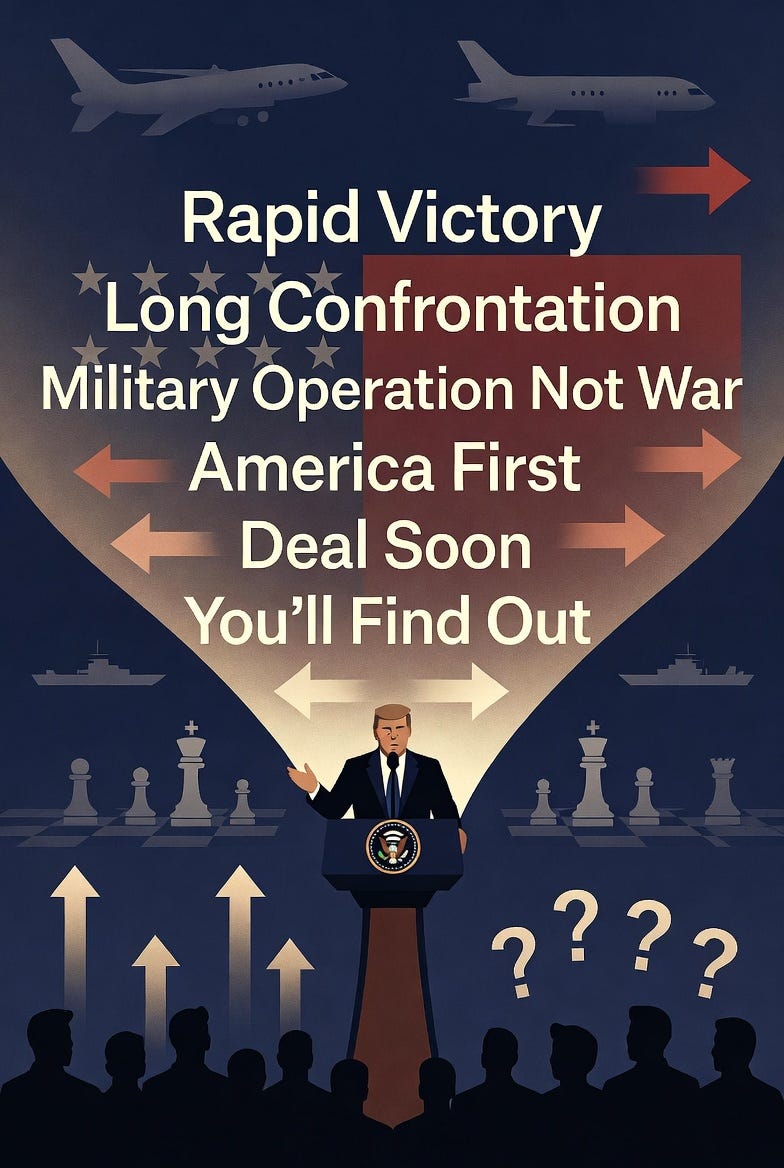
Strategic Communication Ambiguity
Traditionally, countries entering into a war will provide their citizenry with a clear understanding as to why it is being undertaken. War is a matter of life and death…literally. It is also the most important decision that any leader or government will make during his/her/its time in office. Every war that is launched is a big risk, and clearly communicating the goals of such a risk is required to try to beef up support for such a tricky venture.